


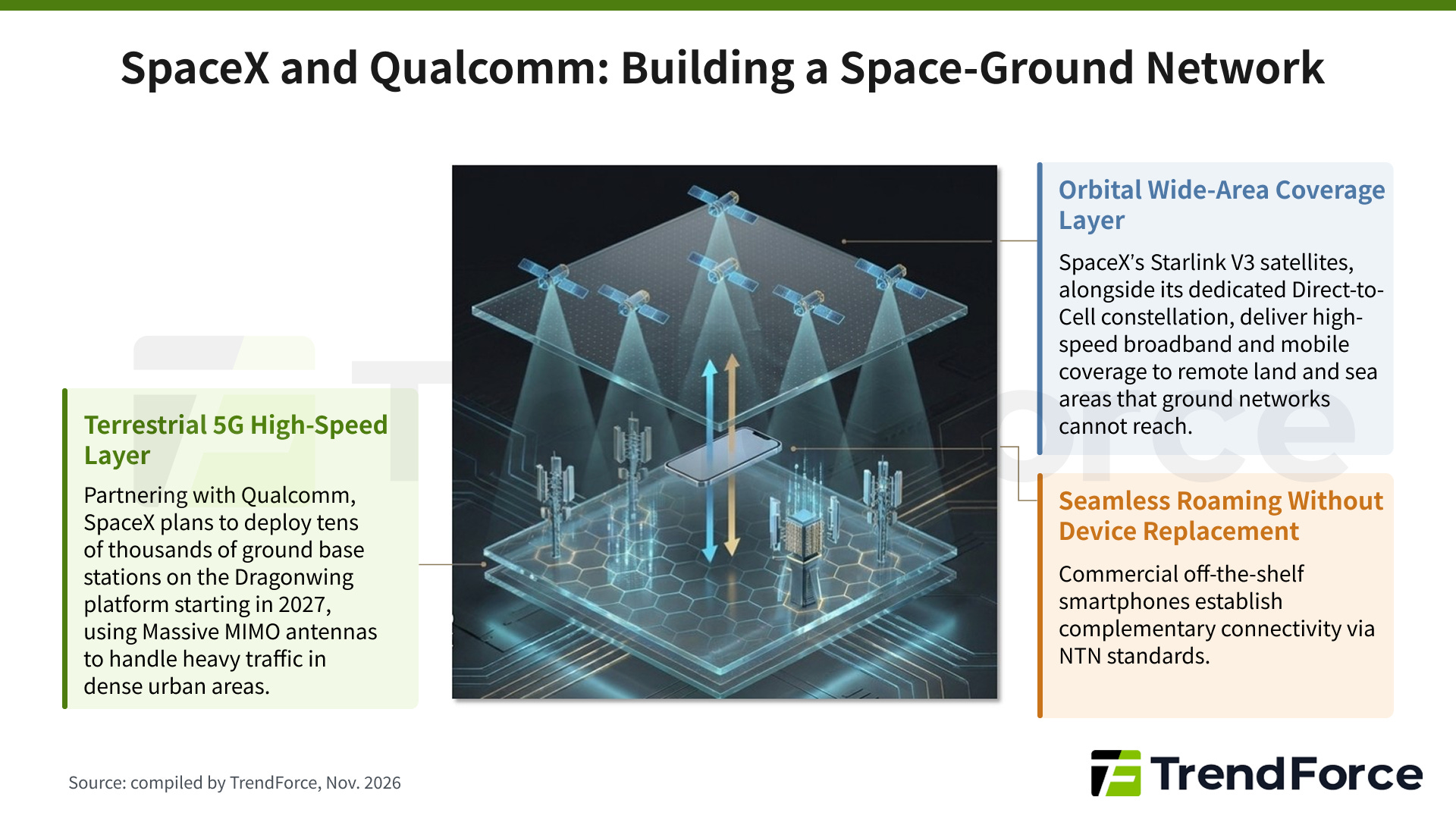
On November 4, 2026, SpaceX and Qualcomm announced a multi-year strategic agreement to build Starlink Mobile’s 5G network. SpaceX plans to begin large-scale deployment of tens of thousands of terrestrial 5G cell sites across the U.S. in 2027, using Qualcomm’s Dragonwing cellular infrastructure platform. The ground network will work alongside Starlink’s global satellite coverage. Qualcomm called it its “biggest 5G deal yet.”
Why would a company known for rockets and satellites need cell towers on the ground? The answer starts with a gap between scale and speed. As of October 30, 2026, SpaceX had launched more than 13,000 Starlink satellites, with over 11,000 operating in low Earth orbit, serving 9 to 10 million users across 150 to 160 countries and regions. Yet Starlink’s first-generation Direct-to-Cell service, which connects ordinary smartphones to satellites, delivers real-world speeds of only about 1 to 4 Mbps per user. That is enough for emergency text messaging and basic low-speed data, but far short of the mobile broadband experience most smartphone users expect.
Three Bottlenecks Holding Back Satellite-to-Phone Service
Even with large phased-array antennas on board, Starlink’s first-generation Direct-to-Cell service faces three hard limits:
Narrow spectrum: Partner carriers allocate only about 5 to 10 MHz of cellular spectrum.
Weak handset signals: A phone transmits at only about 23 dBm, and the signal fades sharply over the hundreds of kilometers to a satellite.
Limited satellite payload and beam capacity: First-generation direct-to-cell satellites offered a total throughput of only about 10 to 20 Mbps per beam, shared among all users within the coverage area.
In other words, true 5G mobile broadband will require both an overhaul of satellite hardware and, through the Qualcomm deal, a network on the ground.
Below, we break down how Qualcomm’s Dragonwing platform splits the work with the Starlink constellation, SpaceX’s segment financials, what the move means for U.S. carriers and Qualcomm, and the key hurdles ahead of the 2027 rollout.