


This Week in 30 Seconds
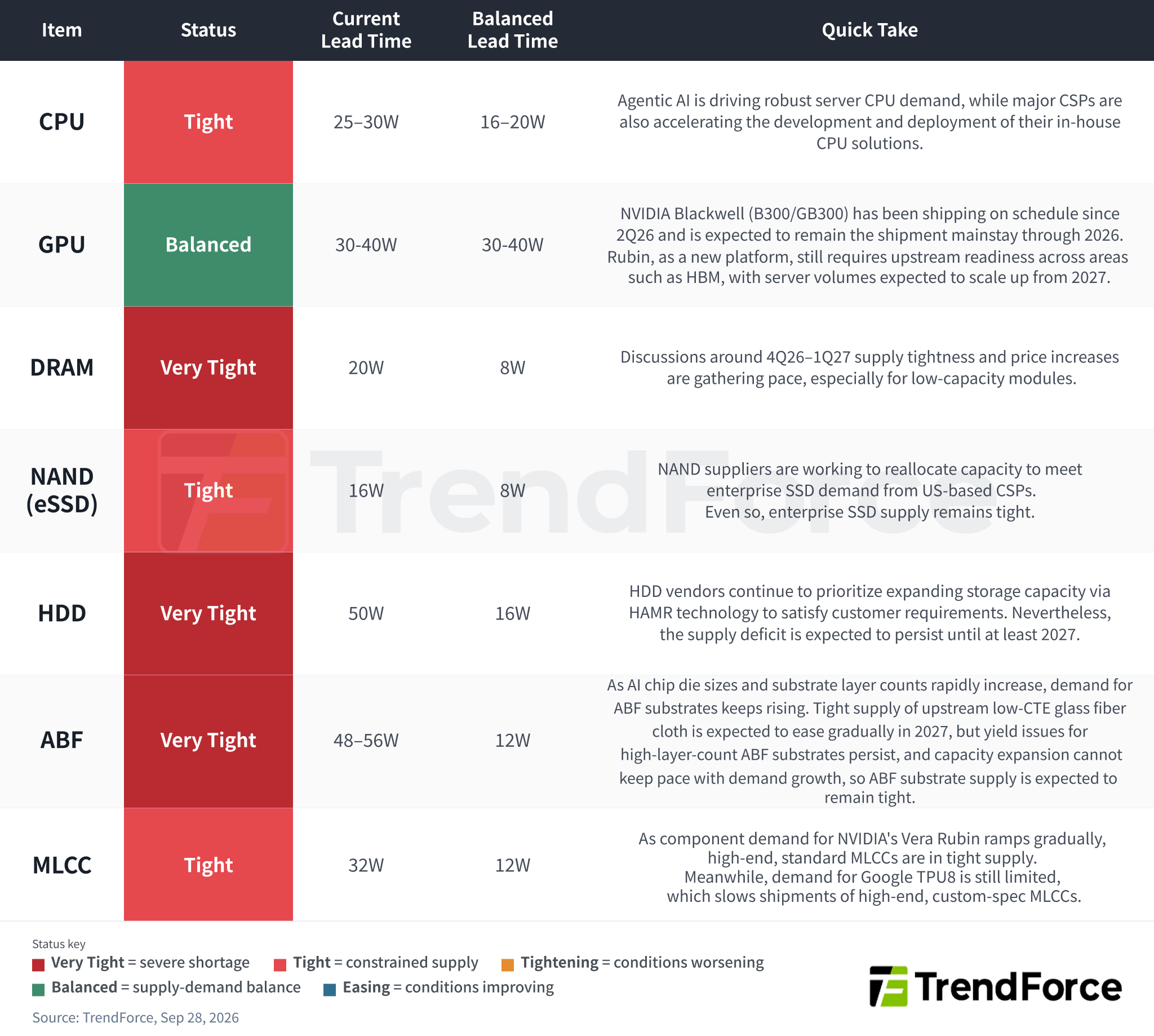
Server CPUs join the Radar this week, a sign of how fast agentic AI has moved them up the watch list. Lead times are at 25 to 30 weeks against a balanced 16 to 20, with major CSPs also accelerating their own in-house designs.
The US and China extended their trade truce by two months, to January 10, after the Trump-Xi summit in Washington, while also agreeing to establish a bilateral AI dialogue.
Micron reports fiscal Q4 this week, its first read since DRAM and NAND prices surged last quarter. The question is whether the memory rally still has room to run, with HBM4 progress the bigger test.
01 / Supply Chain Radar
We track CPU, GPU, DRAM, NAND, HDD, ABF, and MLCC each week. Start with the status color, then compare the current lead time with the balanced-market benchmark and read the quick take.
02 / Last Week in Tech: Top 3 Industry Shifts
AI / ECONOMY
Trump-Xi Summit Extends Trade Truce, Launches New AI Dialogue
What Happened: The U.S. and China wrapped up a three-day summit in Washington with several agreements aimed at stabilizing bilateral ties. The two sides confirmed a two-month extension of their trade truce through January 10, 2027, and agreed on more favorable tariff treatment for US$30 billion of non-sensitive goods in each direction. They also agreed to establish a bilateral AI dialogue, referred to by the U.S. as the U.S.-China Super Intelligence (SI) Dialogue, with the next exchange expected by November 2026. The two sides also agreed to establish a communication channel for AI-related incidents.
Why It Matters: The summit removes an immediate tariff escalation risk while creating more structured channels for trade, investment and AI discussions. But major disputes over technology restrictions and critical-mineral supply remain unresolved. With Trump and Xi expected to meet again at APEC in November and the G20 in December, the Washington summit looks more like another step in an extended negotiation than a final settlement.
AI / SEMICONDUCTOR
Meta’s Muse Ignites a CPU Rally, Extends into Hardware at Connect 2026
What Happened: Meta’s new AI agent Muse has reportedly out-downloaded ChatGPT in its first days on the market, and Wall Street is drawing a direct line to chip demand: because Muse runs on persistent cloud-based virtual machines, the market is betting agentic AI will lean far more heavily on CPUs than GPUs. The bet sent AMD, Intel and Arm surging in lockstep, with AMD crossing a $1 trillion market cap for the first time.
Why It Matters: Muse’s early momentum is quickly expanding beyond software. Its breakout comes as Meta kicks off Connect 2026 (Sept. 23–24), where the company is extending the assistant into hardware with Meta Charm, a compact handheld device built around Muse. With OpenAI reportedly developing a rival as competition with xAI’s Grok “teammates” intensifies, the agent race is widening—and so is the battle over the compute behind it. For chipmakers, the key question is whether always-on AI agents can sustain a new wave of CPU demand, or whether GPUs ultimately capture most of the upside.
SEMICONDUCTORS
Qualcomm Goes 2nm with Dual Flagship Chipsets
What Happened: Qualcomm entered the 2nm era at Snapdragon Summit on Sept. 22, unveiling a dual-flagship lineup — Snapdragon 8 Elite Extreme Gen 6 and Snapdragon 8 Elite Gen 6 — both built on TSMC’s 2nm process.
Why It Matters: Qualcomm’s move puts it just one week behind MediaTek, which launched its own 2nm Dimensity 9600 Pro on Sept. 15 — meaning Android’s two dominant chipmakers have both crossed into 2nm, with Apple’s A20 Pro also on the same node. The convergence hands TSMC a fresh wave of 2nm orders just as it ramps capacity. The chips also mark the first commercial validation of Samsung’s LPDDR6, confirming the new memory standard is ready to ship alongside next-gen silicon.
03 / Week Ahead: Key Events to Watch
TUE. SEP 29|OpenAI DevDay
Event: OpenAI DevDay: Altman teases a big agent launch
Why It Matters: Shortly after Meta rolled out its Muse agent, OpenAI takes the stage as the agent race heats up. Altman posted on Sep 15 that a big launch was coming, then marked the event with six ship emojis, tech-speak for “we’re releasing something.”
Key Watch Points: New Model, New Pricing, New Agents
OpenAI is expanding its tools so AI agents can handle multi-step office work directly on its platform, and DevDay could show how far that goes beyond July’s Presence, which deploys agents in customer support, sales and billing. Watch for a next-generation model, a pricing or API overhaul that reshuffles the competitive landscape, and new platform capabilities such as autonomous agents.
WED. SEP 30|Micron Reports Fiscal Q4 Earnings
Event: Micron reports fiscal Q4 results (ended Sep 3), coming off a record quarter as soaring memory prices reshape the DRAM and NAND markets.
Why It Matters: After DRAM and NAND ASPs surged by the low-60% and mid-80% ranges last quarter, Micron’s results will test whether the memory rally still has room to run—especially as LTAs lock in more supply amid lingering market uncertainty.
Key Watch Points: Margins, Supply Locked-In, HBM4 Catch-Up
Margins hit a record 84.9% non-GAAP in 3QFY26, best among the Big Three — the question is whether that holds. Micron has locked in 16 Strategic Customer Agreements, with markets watching for more. The bigger test is HBM4: still last in shipment share, Micron needs concrete progress to close the gap.
THU. OCT 1-2|3D IC 2026 Conference
Event: 3D IC 2026 Conference takes place in Atlanta
Why It Matters: AI chips are outgrowing flat 2.5D packaging, so the industry is stacking upward into 3D while testing alternatives such as panel-level packaging. With TSMC, Rapidus and Kioxia on the program, the event offers a look at how leading foundries and memory makers plan to stack, connect and scale the next generation of AI silicon.
Key Watch Points: Panel-level Packaging, CMOS Directly Bonded to Array (CBA) for Memory
Beyond its 2nm push, Rapidus is reportedly developing packaging for both 300 mm wafers and 600 mm panels, while Kioxia is expected to detail CBA, the bonding technology behind its next-gen QLC 3D flash and a claimed 60% jump in bit density over its 8th-generation product.