


This Week in 30 Seconds
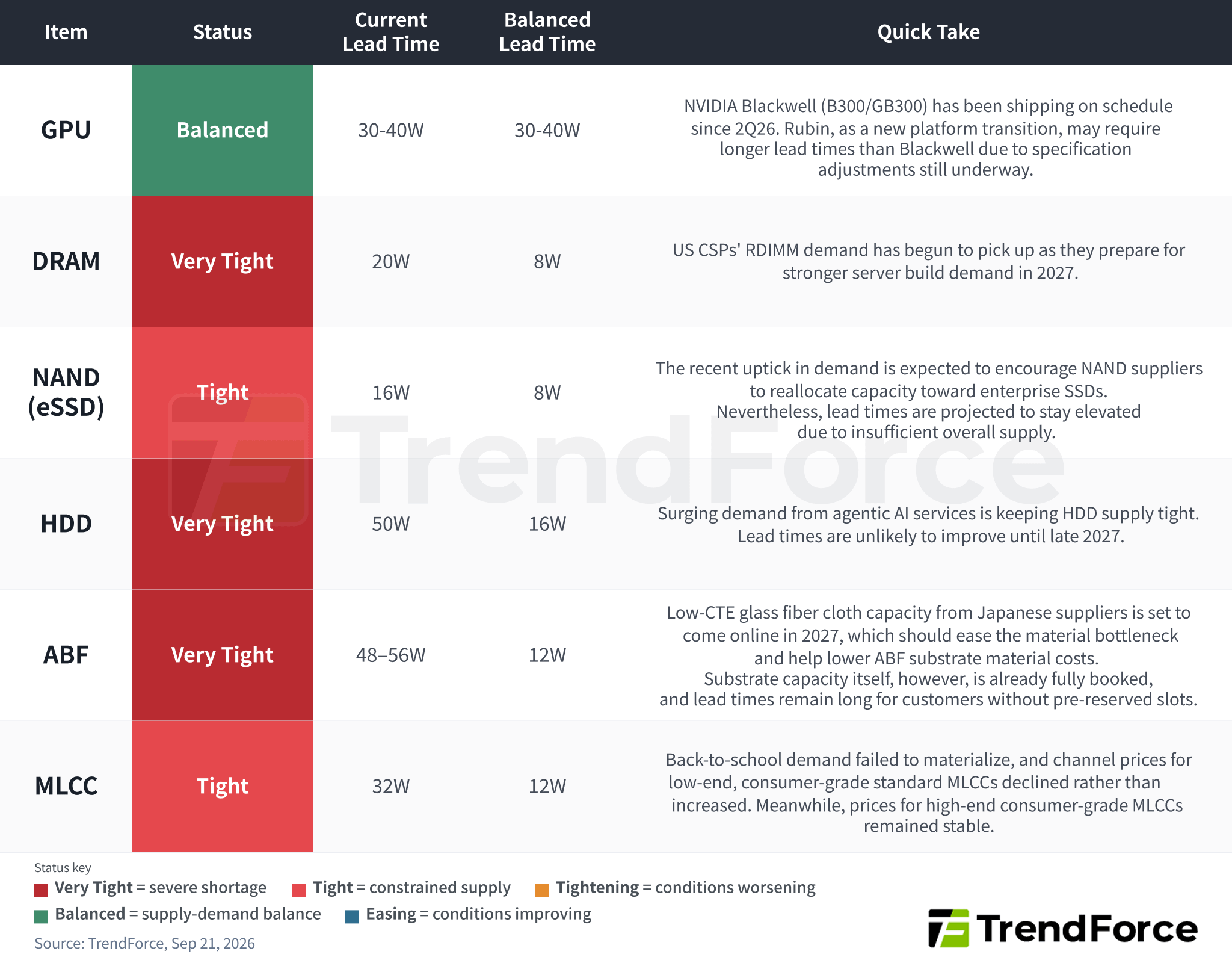
With demand picking up, NAND suppliers are reallocating capacity toward enterprise SSDs, though eSSD lead times remain elevated at 16 weeks against a balanced 8, as overall supply stays insufficient.
SK hynix is reportedly in early talks with Intel to produce memory chips on U.S. soil. The supply chain question is whether this marks the start of South Korean memory makers manufacturing leading-edge chips overseas.
Trump and Xi meet in Washington this week, with rare-earth export controls and AI chip restrictions on the agenda. Watch whether Washington eases chip export rules to China.
01 / Supply Chain Radar: Where the Six Sit This Week
We track GPU, DRAM, NAND, HDD, ABF, and MLCC each week. Start with the status color, then compare the current lead time with the balanced-market benchmark and read the quick take.
02 / Last Week in Tech: Top 3 Industry Shifts
MEMORY
SK hynix, Intel Reportedly Explore U.S. Memory Manufacturing Partnership
What Happened: SK hynix is reportedly in early talks with Intel to jointly produce memory chips on U.S. soil — either by leasing space at Intel’s long-delayed Ohio fab or forming a joint venture. The move would run alongside SK hynix’s existing Indiana HBM back-end packaging plant, slated to begin operations in 2029.
Why It Matters: If realized, this would mark the unprecedented debut of South Korean memory giants producing cutting-edge chips overseas. Beyond easing SK hynix’s U.S. expansion, a joint venture could pioneer a new co-investment model for CSPs to directly secure dedicated memory capacity in the AI era, though strict tech-export controls in Seoul still pose a major regulatory hurdle.
AI/ SEMICONDUCTOR
Huawei Fast-Tracks AI Chip Roadmap to Narrow Gap with NVIDIA
What Happened: Huawei has unveiled an accelerated Ascend roadmap as China doubles down on chip self-sufficiency. Following this year’s debut of the Ascend 950PR and 950DT, Ascend 960DT has been pulled forward by three quarters to early 2027, with the 960PR also moving up a quarter to 3Q27 — narrowing China’s timeline in catching up with NVIDIA.
Why It Matters: Huawei’s push hinges on a critical unknown: whether it can scale AI chip output without direct access to HBM, relying instead on in-house memory alternatives HiBL and HiZQ. And while DeepSeek’s reportedly plan to deploy at least 160,000 Ascend 950DT chips signals growing traction, its continued reliance on NVIDIA GPUs for training shows Huawei’s chips have yet to prove themselves in the most demanding, compute-intensive workloads.
AI / SERVER
Apple Mulls Potential Return to Server Market
What Happened: Under new CEO John Ternus, Apple is reportedly exploring a return to the enterprise server market, marking a potential new frontier for its in-house silicon push. The systems could be powered by M8 Ultra chips, Apple’s highest-performance processors.
Why It Matters: A confirmed launch would mark several milestones for Apple’s silicon strategy. First, its most powerful chips — long confined to consumer devices — would finally be built for the enterprise. Second, selling those systems to outside customers would revive a business Apple walked away from when it discontinued Xserve in 2011. Third, turning to NVIDIA’s NVLink to connect multiple chips would likely mark a reversal from Apple’s earlier alignment with UALink.
03 / Week Ahead: Key Events to Watch
TUE. SEP 22|Qualcomm Snapdragon Summit
Event: Qualcomm’s Snapdragon Summit 2026 kicks off September 22–24, with new flagship smartphone chips set to take center stage.
Why It Matters: Snapdragon Summit isn’t just a smartphone event anymore. Last year brought the 2nd-gen Snapdragon X Elite for PCs and a 3rd-gen Oryon CPU, plus Qualcomm’s push into AI data centers and the custom ASIC market. The question for 2026: does Qualcomm double down on that expansion, or is another surprise in store?
Key Watch Points: Snapdragon 8 Elite Gen 6/ Gen 6 Pro, AI Accelerator Updates:
With MediaTek already shipping its first 2nm chip (Dimensity 9600), attention turns to Qualcomm’s next move — its Gen 6 is also expected to be built on TSMC’s 2nm process. The company has teased a new Hexagon NPU for the Gen 6 — up to 50% faster INT4 prefill, and tuned for Mixture-of-Experts (MoE) models that activate only a fraction of their parameters per token. Watch for how these AI gains translate into real-world benchmarks, and how pricing holds up as both 2nm costs and the ongoing memory price surge squeeze margins.
TUE. SEP 22|Global Memory Innovation Forum 2026
Event: GMIF 2026, a major memory event, kicks off September 22 to 23 in Shenzhen, China
Why It Matters: As AI shifts from training to inference, memory itself is becoming the bottleneck. This year’s theme of GMIF, “The Future Built on AI Memory and Storage,” zeroes in on that shift: how memory and storage must evolve to keep pace with inference-heavy workloads, from enterprise-grade storage and cloud-edge-device collaboration to the emerging Token economy.
Key Watch Points: Updates from Memory Giants (e.g. Samsung on CXL, GDDR7)
Samsung headlines with updates on GDDR7 mass production, CXL memory expansion, and high-performance NAND, joined by fellow memory/storage players SanDisk, Solidigm, and Silicon Motion. Notably, Lenovo — a downstream device maker — also takes the keynote stage. Given the venue, this is also a chance to gauge how far China’s domestic memory technology has progressed.
THU. SEP 24|Trump-Xi Summit
Event: U.S. President Donald Trump Expected to Meet Chinese President Xi Jinping in Washington
Why It Matters: This marks Trump and Xi’s second meeting this year, following their May summit in Beijing, and is expected to center on extending the US-China trade truce — including tariff relief on American energy and agricultural exports — with the broader race for AI supremacy also expected to shadow the talks.
Key Watch Points: Tariff adjustments, export controls on rare earths, AI chips
China’s dominance as the world’s top rare-earth producer gives Beijing real leverage over tariff concessions on the table. On the AI front, whether Washington eases chip export restrictions to China remains the central question — one that carries extra weight with NVIDIA CEO Jensen Huang reportedly attending Trump’s state dinner for Xi.