


Discussions of AI server capacitor demand have largely centered on multi-layer ceramic capacitors (MLCCs): rising consumption, shortages of high-capacitance products, and growing need for high-voltage components. But as power integrity requirements intensify across AI servers and high-performance computing (HPC), another component is drawing increasing attention: silicon capacitors.
In May 2026, Samsung Electro-Mechanics announced a silicon capacitor supply contract worth approximately USD 1 billion with a major global customer, covering deliveries through 2027 and 2028. A month later, the company outlined its strategic direction, pointing toward an integrated approach that bundles silicon capacitors, MLCCs, and package substrates. This reflects a broader market trend: silicon capacitors are emerging as vital complementary components for package-level power integrity.
What roles do silicon capacitors and MLCCs each play in power integrity, and how do they complement each other? This article examines the technical characteristics of both, and the supply chain dynamics.
Related report: MLCC Market Outlook 1Q26~2Q26
Power Integrity Moves Inside the Package
As GPUs’ thermal design power (TDP) rapidly escalates, components such as power shelves, VRMs, DC-DC converters, and OAM boards require significantly more MLCCs for filtering and voltage regulation so as to prevent voltage ripples from compromising computational stability. In the meantime, as AI accelerator platforms evolve to incorporate chiplets, HBM, and high-density advanced packaging, power integrity challenges are no longer confined to the PCB level; they are penetrating deeply into the package itself.
In a multi-die architecture, a single GPU package might house a compute die, an I/O die, and an NVLink I/O die. Together with HBM, silicon interposers, and package substrates, these components form a highly dense system. Every individual die and power domain necessitates an independent, rapidly responding decoupling network. Relying exclusively on board-level MLCCs creates excessively long current paths, introducing parasitic inductance that severely throttles transient response speeds.
Silicon Capacitors’ Advantages
Manufactured using semiconductor fabrication processes, silicon capacitors utilize a silicon substrate paired with thin-film dielectric materials like silicon oxide or silicon nitride. Unlike traditional MLCCs—which generate capacitance through alternating layers of ceramic dielectrics and metal electrodes—silicon capacitors align more closely with semiconductor manufacturing principles. They leverage techniques such as thin-film deposition, deep trench structures, and customized packaging to increase capacitance per unit area while minimizing parasitic inductance.
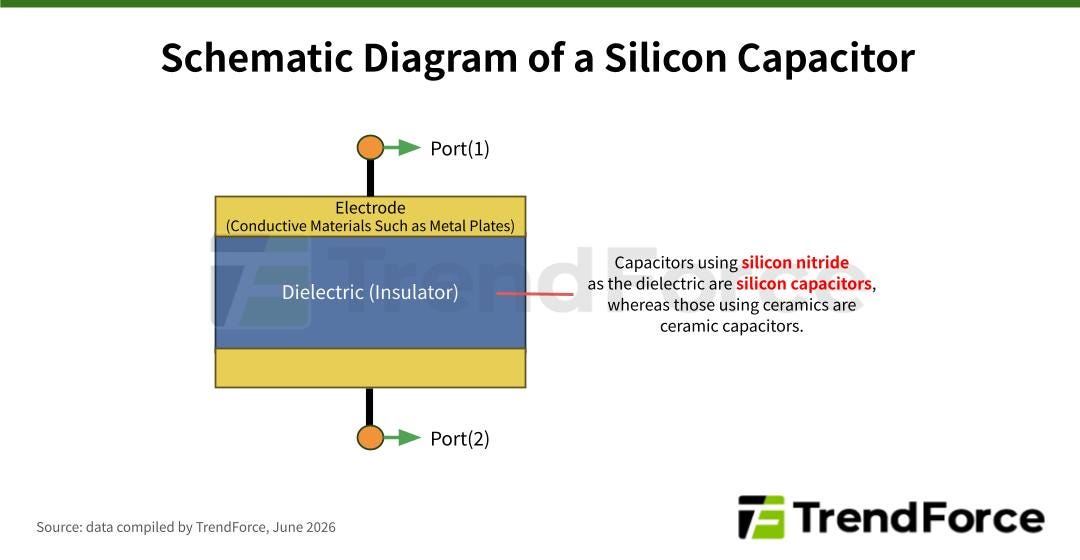
The defining characteristics of silicon capacitors are their exceptionally low equivalent series inductance (ESL) and their ability to be placed in close proximity to the chip. During high-load operations, the current demands of AI GPUs, CPUs, ASICs, and HBMs fluctuate rapidly within fractions of a second; minimizing ESL ensures the capacitor can rapidly compensate for instantaneous power demands and maintain rigorous power stability, which is precisely the core value of silicon capacitors for near-die decoupling inside the package.
A further advantage of silicon capacitors is their superior capacitance stability across high frequencies, temperature variations, and DC bias. In environments with high DC bias or elevated temperatures, MLCCs utilizing certain material compositions often suffer from capacitance degradation or unpredictable fluctuations. By contrast, silicon capacitors—benefiting from silicon-based thin-film dielectrics and precise semiconductor manufacturing—deliver exceptional capacitance stability and dimensional accuracy. This makes them highly suitable for applications requiring high-density mounting, rapid high-frequency response, and unwavering capacitance.
Related report: NVIDIA FY1Q27 AI Server Outlook: GB/VR Rack Leads
Different Jobs, Different Layers
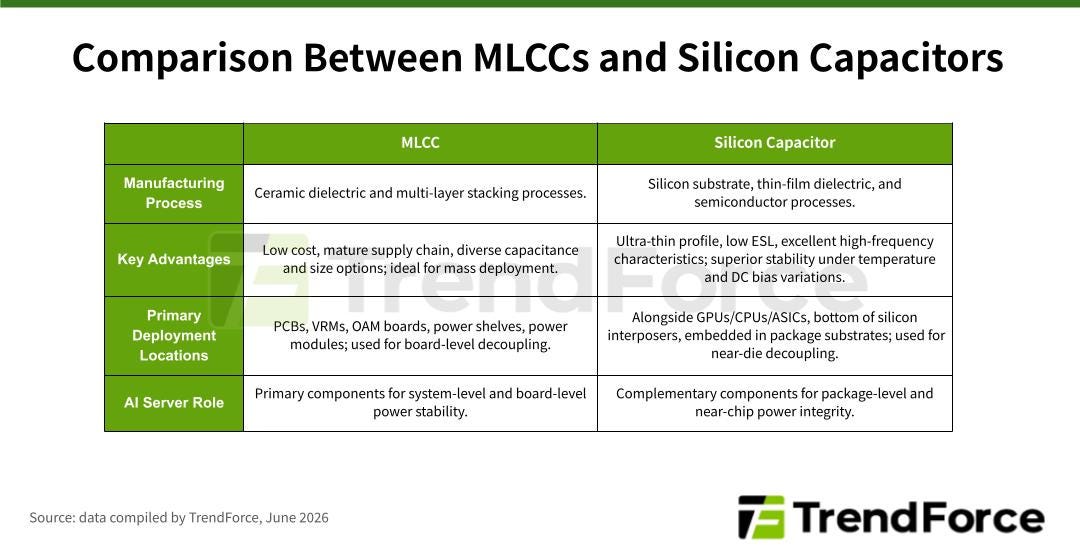
MLCCs serve as the primary components for system-level power stability in AI servers, offering unparalleled advantages in cost, supply scale, maturity, and mass deployment. As AI servers transition into the Rubin generation, the simultaneous increases in GPU power consumption, HBM density, NVLink bandwidth, and high-speed networking chip requirements will continue to drive the expansion of MLCC usage. TrendForce notes that while a single NVIDIA GB200 board requires approximately 6,500 MLCCs, the next-generation Rubin architecture—featuring double the TDP and significantly more complex power management—will push per-board usage to roughly 12,000 units.
Silicon capacitors, on the other hand, provide a high-end solution for package-level power integrity in AI accelerators, excelling in low ESL, ultra-thin profiles, high-frequency stability, and custom integration.
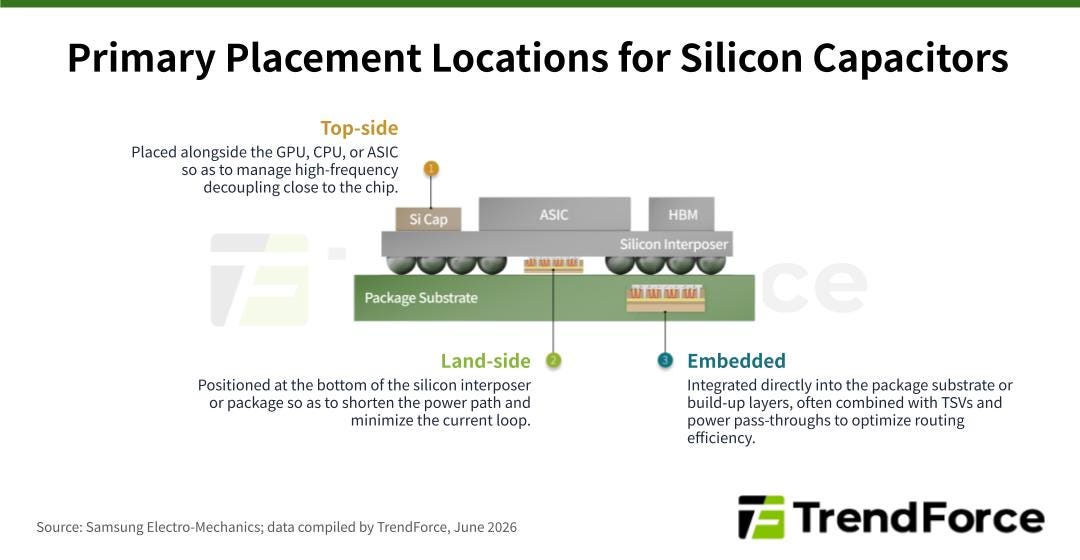
Depending on placement requirements, silicon capacitors can be configured in top-side, land-side, or embedded formats, and positioned alongside GPUs, CPUs, or ASICs, at the bottom of silicon interposers, or embedded within the package substrate itself. The closer the capacitor is to the die, the shorter the current loop and the lower the parasitic inductance, which is critical for suppressing transient voltage fluctuations and high-frequency noise.
The relationship between MLCCs and silicon capacitors should therefore be understood as complementarity, not substitution.
Supply Chain Dynamics
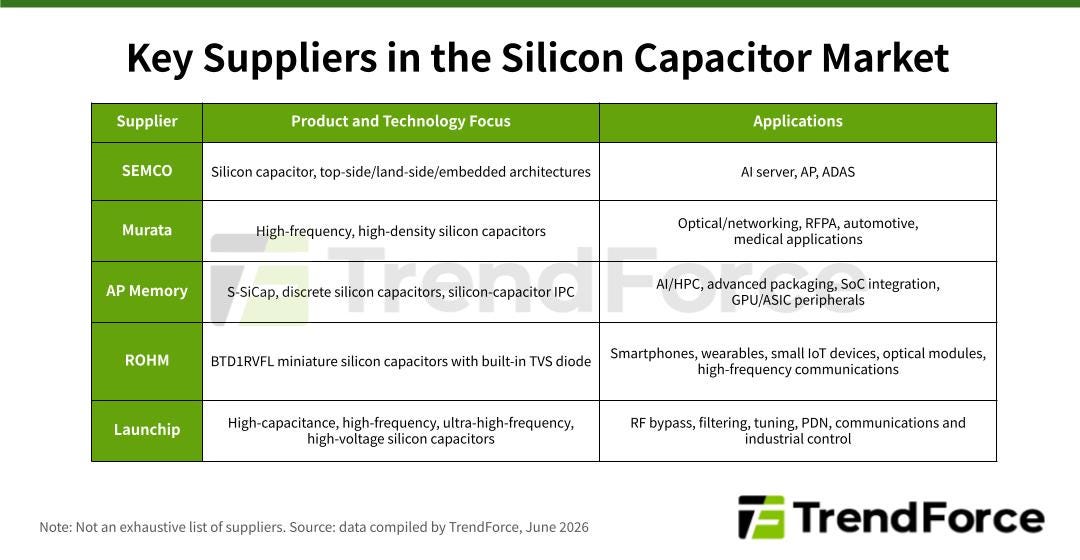
MLCCs mainly use traditional passive component processes, dominated by established players such as Murata, SEMCO, Taiyo Yuden, and Yageo. In contrast, the silicon capacitor supply chain is more closely aligned with semiconductor processes and advanced packaging. TrendForce believes that the core competency for silicon capacitor vendors lies in their ability to co-design with AI GPU, ASIC, HBM, and packaging platforms, and to pass qualification by high-end customers. Overall, silicon capacitors carry higher entry barriers and longer customer qualification cycles, and the supply scale remains relatively limited.
Outlook: A Dual-Track Future
The key to silicon capacitors’ future growth is not to completely replace MLCCs, but to ride the rising penetration of advanced AI packaging and gradually become standard components inside GPU, ASIC, and HBM packages. However, several challenges remain, including cost and supply scale, customer validation cycles, and a high degree of design binding.
In the long term, capacitor demand in AI servers will evolve into a dual-track structure of board-level MLCCs and package-level silicon capacitors. MLCCs will continue to benefit from rising per-rack power consumption and growing demand for high-capacitance and high-voltage products, while silicon capacitors will benefit from PDN upgrades inside AI accelerator packages, tighter HBM integration, and the proliferation of chiplet architectures.
For a full analysis of silicon capacitor technology, supplier dynamics, and market outlook, access our report: Power Integrity Upgrades in AI Servers: Evolving Roles of Silicon Capacitors and MLCCs.
The disadvantage of placing a silicon capacitor (si-cap) near the die is that its ESR is higher compared to an MLCC. It appears that Murata Manufacturing offers a competing silicon capacitor product called the LLF0YK series. However, due to anti-resonance issues, it will be interesting to see which option holds the advantage, depending on the client's design philosophy and cost trade-offs
Murata sits on both your lists, and that’s the underrated part: it’s been in silicon capacitors since acquiring IPDiA (Caen, France) in 2016 — nearly a decade before “package-level” became a headline. So the dual-track future likely extends the Japanese MLCC incumbents rather than disrupting them: the leader that owns the board is already furthest along inside the package.