


With Apple reportedly set to unveil its first foldable iPhone in fall 2026, the market’s attention has turned back to foldable technology. This is not a specs leak or a rumor roundup, but a broader analysis of how Apple’s entry reshapes the competitive landscape and what technological shifts are quietly redefining what a foldable display can be.
Apple’s entry in 2026 is expected to reinvigorate the foldable market. TrendForce estimates that Apple, leveraging its strong brand positioning and consumer anticipation, could capture nearly 20% market share in 2026, compressing the share of competitors such as Samsung Electronics and Huawei to around 30% each.
As for the technology itself, the competitive focus is shifting beyond hinge mechanics and structural optimization toward materials science. Foldable devices are entering a critical phase on the path toward creases that are truly imperceptible.
Related report: Quarterly Smartphone Market Status Update - 2Q26
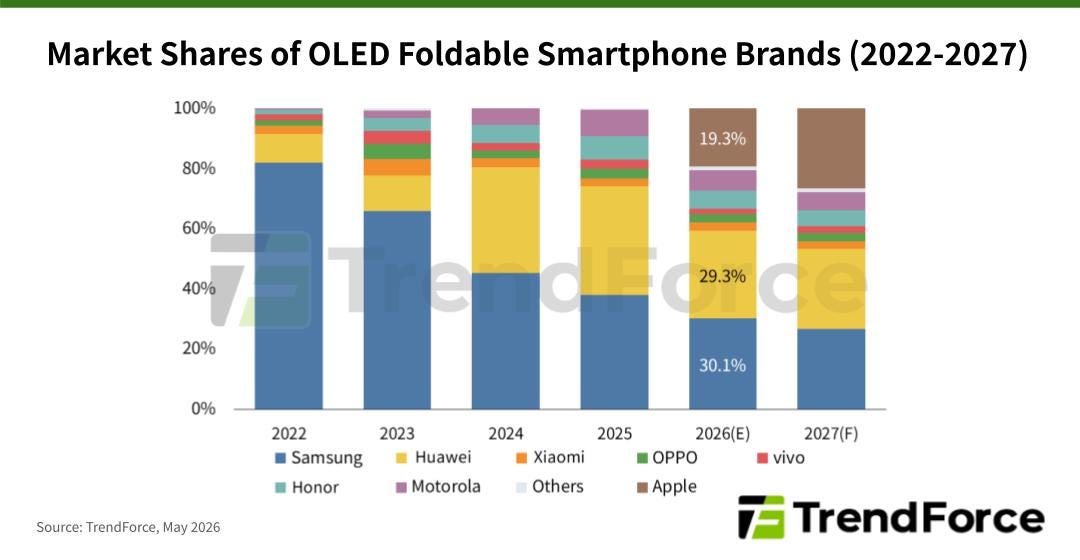
From Foldable to Creaseless: Three Phases of Development
From Samsung’s crease-free display panel showcased at CES 2026 to OPPO’s recently launched Find N6, marketed around a “virtually crease-free” design, the industry’s appetite for a genuine breakthrough is clear.
Creases originate from the misalignment of the neutral layer within the panel stack, which causes localized tensile stress, leading to micro-cracks or permanent deformation under stress concentration. Solving this problem has driven the industry through three distinct phases of development.
Phase one (2019-2022): feasibility verification
The central question at this stage was whether a foldable device could fold reliably. Technical efforts focused on panel durability and hinge lifetime. Early products commonly used U‑shaped hinges, which forced the panel into a small bending radius when folded, causing strong stress concentration and deeper, more visible creases.
This then evolved into water drop hinge design, which increased the bending radius to distribute stress more evenly, significantly improving both panel lifetime and crease performance. Some manufacturers also introduced dual-track floating support structures that brace the panel from beneath when unfolded, helping the display lie flatter.
Phase two (2023-2025): structural optimization
At this phase, the focus was mass production and reliability improvement, with the goal of simplifying mechanisms and upgrading materials to improve assembly yield and overall product durability.
On the mechanical side, smartphone brands gradually reduced the number of components, optimized assembly processes, and introduced techniques such as welding, mortise-and-tenon joints, and 3D printing to improve overall production quality and consistency. On the materials side, they moved beyond traditional SUS stainless steel to aerospace‑grade alloys, carbon fiber, and reinforced composites, and began experimenting with novel materials like liquid metal to better balance strength and weight, enabling thinner, lighter, yet more durable product designs.
In addition, unified specs and design languages emerged: water drop hinges became the mainstream structural solution, clamshell and in-folding emerged as the two primary form factors, and key mechanisms such as sliders and cantilever supports settled into relatively fixed design architectures.
Phase three (2026~): material dominance
By 2024-2025, mechanical optimization had gradually approached its limits. Water drop hinges, floating supports, and multi-link designs — even with ever-higher precision — could make creases less noticeable, but could not make them truly disappear. This pushed the industry to rethink the problem at its core: a crease is not merely a structural issue, but the result of material deformation and fatigue under repeated stress.
Therefore, starting in 2026, the industry has shifted its focus toward materials engineering to actively regulate stress distribution and prevent bending stress from concentrating in a single region.
The crease problem is gradually moving from a visible defect toward something almost imperceptible — laying the foundation for a truly mature foldable product.
So what is actually driving this materials-led transformation? The answer lies in two key materials: UTG and OCA.
UTG: From Protective Layer to Core Mechanical Component
In the past, UTG was primarily used as a surface protective material, providing hardness, scratch resistance, and tactile feel. In next-generation foldable devices, it has become the structural core that defines how stress is distributed across the display stack.
The key design shift starts with thickness redistribution. Traditional homogeneous glass applies a single thickness across the entire panel, forcing a trade-off between strength and flexibility. Under a non-uniform thickness design, the folding area is precisely thinned to improve flexibility and reduce stress concentration, while non-folding areas maintain a greater thickness to preserve rigidity and impact resistance.
This design philosophy is also reflected in Apple’s foldable device patents.
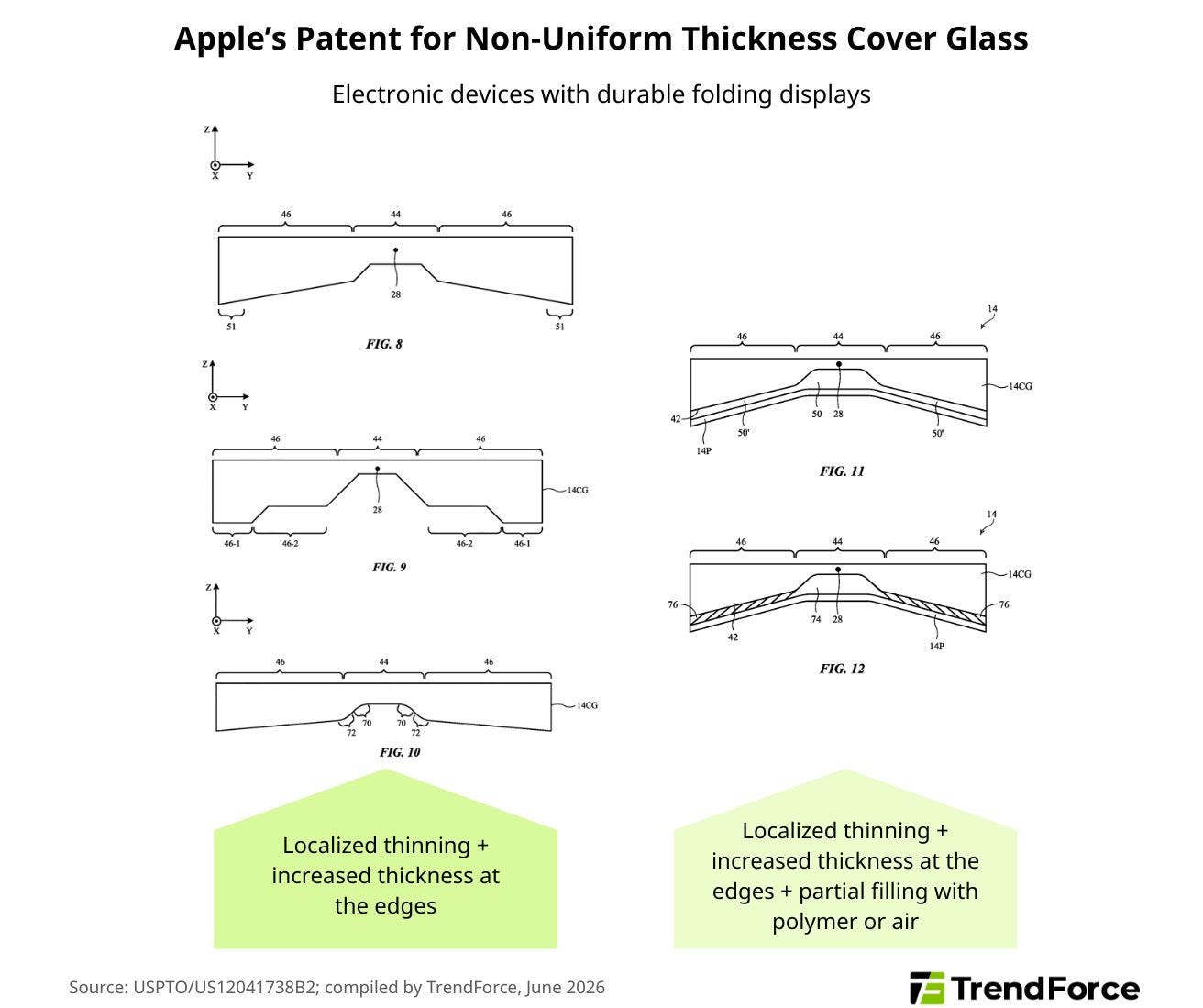
Through chemical strengthening and multi-layer surface coatings, UTG’s resistance to cracking and fatigue has significantly improved, maintaining structural integrity under repeated folding. That said, UTG remains a high-modulus material whose primary function is to guide stress, not absorb it. Without an intermediary layer capable of absorbing and regulating stress, localized forces can still accumulate at layer interfaces, compromising long-term reliability.
OCA: From Adhesive Layer to Critical Stress Manager and Optical Interface
That intermediary layer is OCA (Optically Clear Adhesive). Once used primarily as an optical adhesive material for display modules, OCA has taken on a far more active role in next-generation foldable displays: dynamically distributing and buffering stress between material layers.
The key lies in the precise design of the material’s viscoelasticity, enabling it to exhibit distinctly different mechanical behaviors under varying strain conditions and time scales. During normal, gradual bending, OCA maintains a lower modulus, staying soft and allowing the stack to conform to deformation while absorbing stress, thereby reducing both fatigue accumulation and micro-crack formation. Under sudden impact, such as a drop or localized press, its modulus temporarily rises to provide structural support and prevent stress from concentrating in any single layer. The result is a material that is soft under everyday use and stiff when it needs to be.
Through these mechanisms, OCA helps stabilize the neutral layer and significantly reduce stress concentration during folding. Its micro-flow characteristics also allow it to fill microscopic irregularities formed over long-term use, reducing light scattering and further minimizing the visible crease.
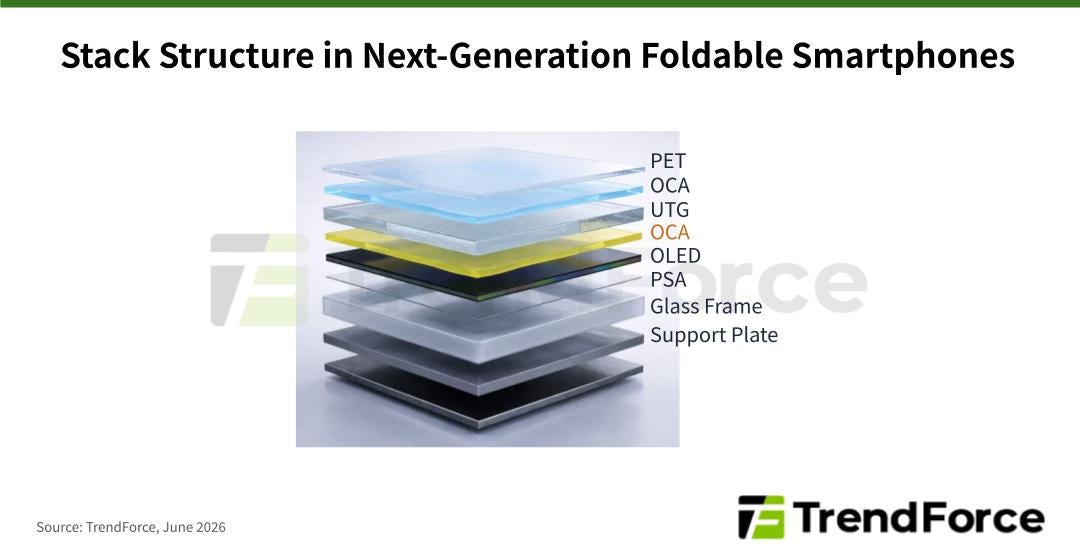
TrendForce View
While material innovation now leads crease reduction, mechanical structures remain critical. The OPPO Find N6, for example, uses precision machining and 3D printing technologies to enhance hinge flatness, while polymer materials fill structural gaps to prevent localized suspension and stress concentration, ensuring stable deformation during repeated folding. Meanwhile, for the metal support plate behind the display, Samsung Display has adopted laser drilling technology to reduce hole spacing in bending areas, achieving a balance between structural rigidity and flexibility, and enabling a near crease-free visual experience.
Essentially, the key to crease improvement has shifted from hinge design to the coordinated management of material modulus, thickness distribution, and stress release. Only when unfolding leaves no trace will foldable phones truly reach the mainstream.
For a deeper dive into material stack design and foldable market forecasts, access the complete analysis here: Last Mile for Folding: Revolution of Crease from Mechanical Structures to Materials Science