


TrendForce 2026 San Francisco Roadshow arrives October 16. Join us to unpack the latest on memory, AI server deployment, and the widening US-China divide in AI infrastructure: REGISTER HERE.
Over the past year, capital expenditures at the five major US CSPs—Amazon, Microsoft, Google, Meta, and Oracle—have doubled, and that growth curve is clearly visible. But CapEx alone may only tell half the story. Financial disclosures reveal another notable trend: signed, not-yet-commenced lease commitments, which have collectively reached approximately US$1.16 trillion across the five. While these payments are not current-period CapEx, they are contractually committed. Amazon’s disclosures cover group-wide mixed uses (e.g., fulfillment centers), while the other four CSPs each specify in their notes that the commitments are data center-related.
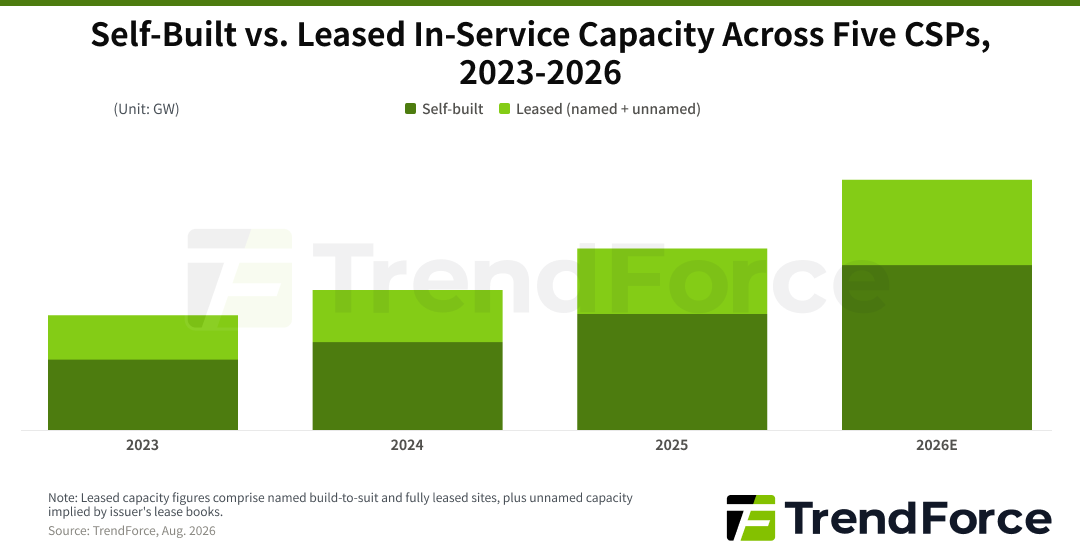
It is evident that self-build construction pipelines can no longer keep pace with the explosive demand for compute capacity. The CSPs are accelerating their reliance on external developers to secure future capacity, marking a strategic shift toward a dual-engine expansion model driven by both self-builds and leasing. In this article, TrendForce analyzes the overall capacity trends, self-build versus leasing strategies of these five CSPs, and what this US$1.16 trillion figure signals for the future of data center expansion.
Related report: NVIDIA Data Center Boom Fuels GB/VR Rack Demand