


Data centers are undergoing a fundamental transformation in power infrastructure as server rack power ratings rapidly climb from the kilowatt to near the megawatt range. The industry is shifting toward HVDC architectures to improve efficiency and reliability, reduce copper usage, and support more compact system designs. Third-generation semiconductors, SiC and GaN, are the critical enablers of this transition.
In 2026, as AI data centers face growing power bottlenecks and EVs accelerate the adoption of high-voltage architectures, SiC and GaN technologies are increasing their share across global infrastructure.
This article explores the deployment of these technologies across AI/data center infrastructure and automotive and industrial systems, while providing insights into the evolving competitive landscape of the global supply chain.
Related report: 2026 AI Factory Infrastructure Outlook: HVDC Power & Liquid Cooling Trends
SiC/GaN Are Entering a Structural Growth Cycle
Driven by the global push toward smart grids, rising energy efficiency standards in AI data centers, and the accelerating adoption of high-voltage EV platforms, power devices are no longer peripheral components—they have become strategic essentials reshaping the global energy landscape.
Leading players such as Infineon, STMicroelectronics, onsemi, and ROHM Semiconductor are deepening vertical integration across the supply chain, transforming into full-stack energy management solution providers. This marks the entry of power semiconductors into a structural growth cycle.
Meanwhile, China’s power semiconductor industry has moved beyond the technology validation phase and is rapidly expanding thanks to national infrastructure strategies.
In 2026, competition will no longer center solely on performance. Instead, it will increasingly hinge on control over critical materials (such as high-quality crystal growth techniques) and advanced packaging capabilities (including silver sintering and pressure bonding).
As leading compound semiconductor technologies, SiC and GaN are driving breakthroughs in crystal growth, epitaxy, and wafer processing. These advances are accelerating the transition from discrete components to integrated modules, meeting market demand for extreme miniaturization and superior thermal performance.
Driven by both AI/data center infrastructure and automotive and industrial systems as dual growth engines, the market penetration of third-gen semiconductors is expected to continue to rise in 2026.
Related report: 2026 Global SiC Power Device Market Analysis Report
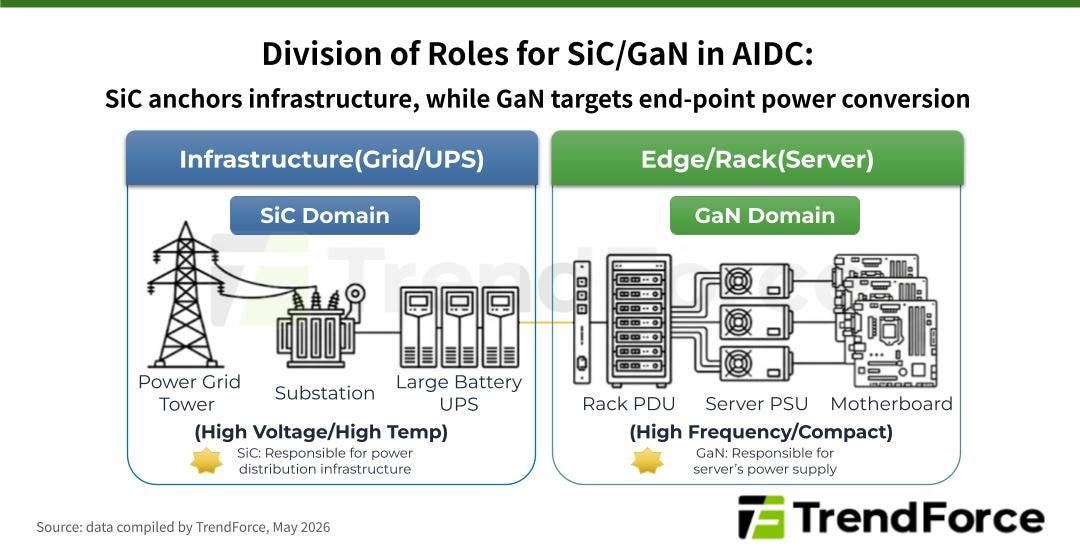
SiC is vital to the front-end and mid-stage power conversion within data center architectures, managing the highest voltages and power loads. With superior thermal performance and switching characteristics, SiC is essential for the development of next-generation solid-state transformers (SSTs).
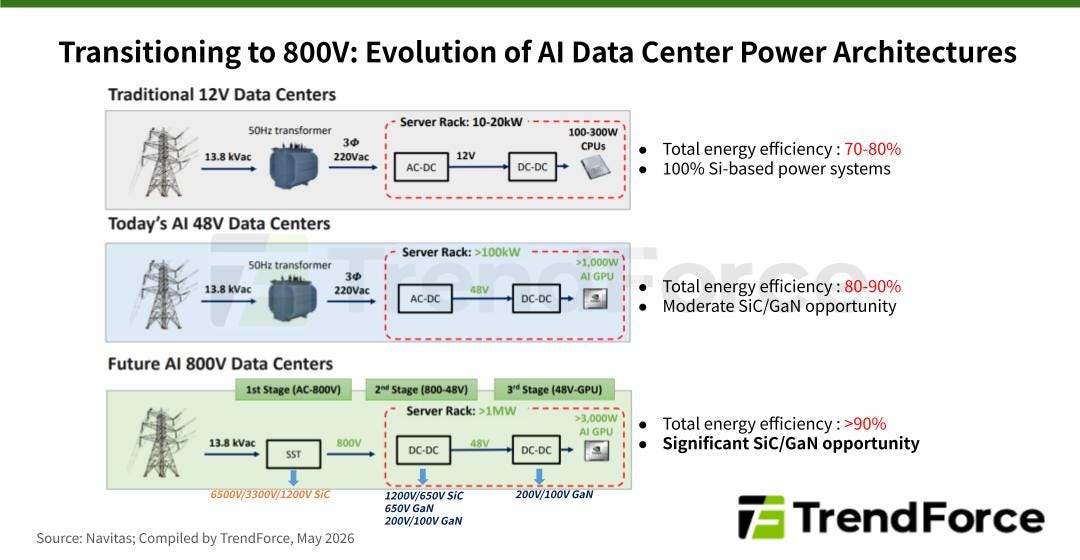
Discussions regarding SSTs have intensified recently. SSTs can directly convert medium-voltage AC from the grid into the 800V DC required for AI infrastructure. Built on power electronics and wide-bandgap (WBG) semiconductor technology, SSTs serve as an alternative to traditional 50/60Hz transformers. Beyond significantly reducing footprint and improving energy efficiency, they offer precise, real-time control over power flow, potentially reshaping the design of medium-voltage power conversion systems.
From an application perspective, SSTs are suited to any scenario requiring efficient medium-voltage AC-to-DC conversion, including AI data centers, renewable energy systems, and EV charging infrastructure—making them a key direction for the next generation of power electronics upgrades. Driven by the extreme demands for power efficiency and density within AI compute clusters, SSTs are rapidly becoming the core solution for power supply transformation in future AI data centers.
Meanwhile, GaN, known for its high-frequency and high-efficiency properties, is becoming increasingly popular in mid- and end-stage power conversion. It supports ultra-high-power density and quick dynamic responses. Typical applications include AI server power units, data center PSUs, telecom power systems, and high-efficiency fast-charging devices. As the rapid proliferation of AI drives up power consumption and density requirements, HVDC architectures and high-efficiency conversion designs are becoming the industry standard. GaN components effectively reduce conduction and switching losses, allowing for significantly smaller magnetic components and a reduced thermal footprint.
Despite its advantages, GaN is still limited in ultra-high-voltage applications and extreme power density scenarios, where it must complement other wide-bandgap materials such as SiC. Furthermore, long-term reliability and durability standards for GaN in certain high-power applications still require further validation and standardization.
SiC/GaN in AI/Data Center Infrastructure
AI development has shifted from cloud-based training to large-scale inference applications, driving upgrades across servers, racks, power systems, and supporting infrastructure such as electrical systems and precision cooling (CRAC/CRAH). Even as AI chip process nodes advance to 2 nm and beyond, scaling alone is no longer sufficient to close the compute gap. Meanwhile, expansion is increasingly constrained by a physical “power wall,” turning AI competition into a fundamentally energy-driven race.
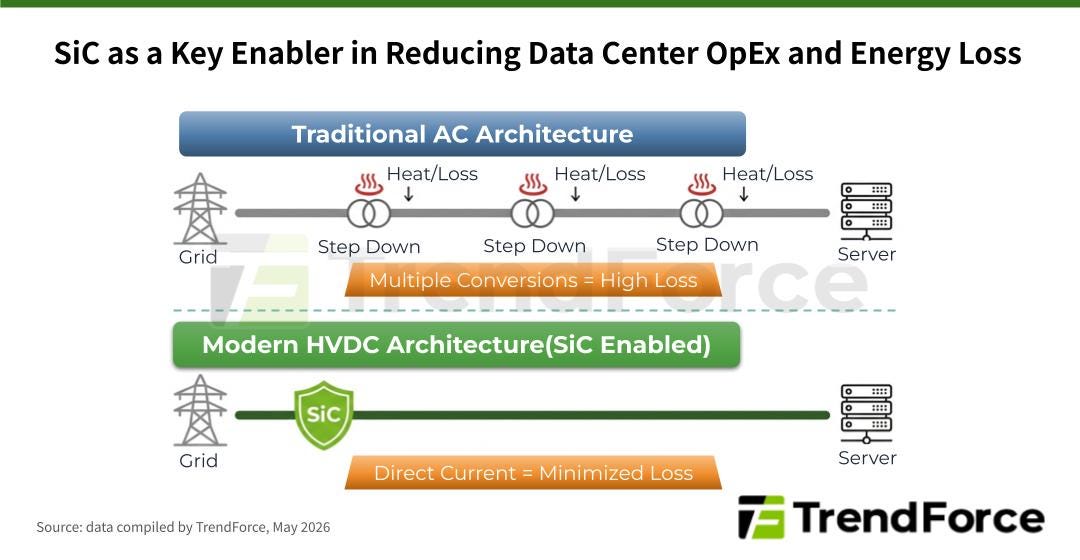
At the front end of power delivery, traditional AC architectures rely on multiple voltage conversion stages, each introducing significant thermal losses. In contrast, SiC-enabled HVDC architectures support direct high-voltage DC transmission, simplifying the conversion chain and minimizing energy loss. This enables a more efficient “grid-to-rack” power structure, forming a resilient and high-efficiency energy backbone for data centers.
At the rack and server level, GaN-based solutions can push power conversion efficiency beyond 96% to meet the highest titanium-level standards for energy efficiency. This translates into lower electricity costs, while significantly improving thermal headroom and power density within servers.
Related report: 2026 AI Server Outlook: CSP Rack Power Scales Up
SiC/GaN in Automotive and Industrial Systems
Global automakers are continuing to adopt 800V high-voltage platforms, driving the expansion of SiC power module capacity and contributing to cost reductions. Across mobility applications, including electric buses and trucks, this high-efficiency architecture is becoming a strategic foundation for improving driving range and charging speed.
Related report: 1Q26 Global Automotive Market Decode
For example, Tesla and BYD are enhancing energy efficiency across core vehicle models by adopting SiC chips and developing key power electronics in-house. Meanwhile, Hyundai and Kia have integrated SiC into their E-GMP platform, achieving a 5% increase in driving range alongside ultra-fast charging capabilities. Even in hybrid systems, Toyota has introduced SiC into the motor controller of its sixth-generation THS to improve PCU (Power Control Unit) efficiency and reduce power loss.
Market trends indicate that SiC and GaN technologies are driving convergence between energy systems and transportation infrastructure. GaN, in particular, is expanding beyond consumer electronics into automotive applications such as on-board chargers (OBC), DC/DC converters, LiDAR systems, and infotainment/audio amplifiers.
Leading companies, including Infineon, STMicroelectronics, EPC, Texas Instruments (TI), and ROHM, have already introduced automotive-grade solutions. For instance, Infineon has begun mass production of its CoolGaN 100V G1 automotive transistors and launched AEC-Q101-qualified GaN components.
Additionally, Tata Electronics has partnered with ROHM to focus on assembly and testing of automotive MOSFET power devices, linking local manufacturing capabilities with the global supply chain. This highlights the expanding structural role of power semiconductors within automotive systems.
Overall, SiC has become the standard specification for main traction inverters in 800V platforms or vehicle models with a driving range of 700km+. Meanwhile, GaN is entering a mass adoption phase. Although its penetration in main traction systems remains lower than SiC, GaN is increasingly favored in on-board charging, lightweight power modules, and LiDAR applications, where it helps reduce vehicle weight and free up interior space.
TrendForce View
From discrete power devices to system-level integration of SiC/GaN modules
SiC and GaN technologies are evolving toward modular integration. Leading vendors are increasingly integrating power chips, isolated gate drivers, and sensors into single modules using advanced packaging technologies. This approach helps overcome the power wall, improves heat dissipation, and reduces system footprint.
Overcoming the AI Power Bottleneck Through Wafer Process Transformation and Advanced Packaging
Wafer process transitions are a key structural driver of capacity increases and marginal cost reductions. The industry is moving toward 12-inch GaN processes, enabling capacity expansion and improved price-performance through scale.
Advanced packaging technologies, including silver sintering and pressure bonding, are critical to achieving superior thermal performance and miniaturization. As power devices shift from discrete components to integrated modules, packaging becomes the determining factor in maintaining long-term reliability under high power density conditions.
Vertical integration and process scaling are reshaping the power electronics landscape
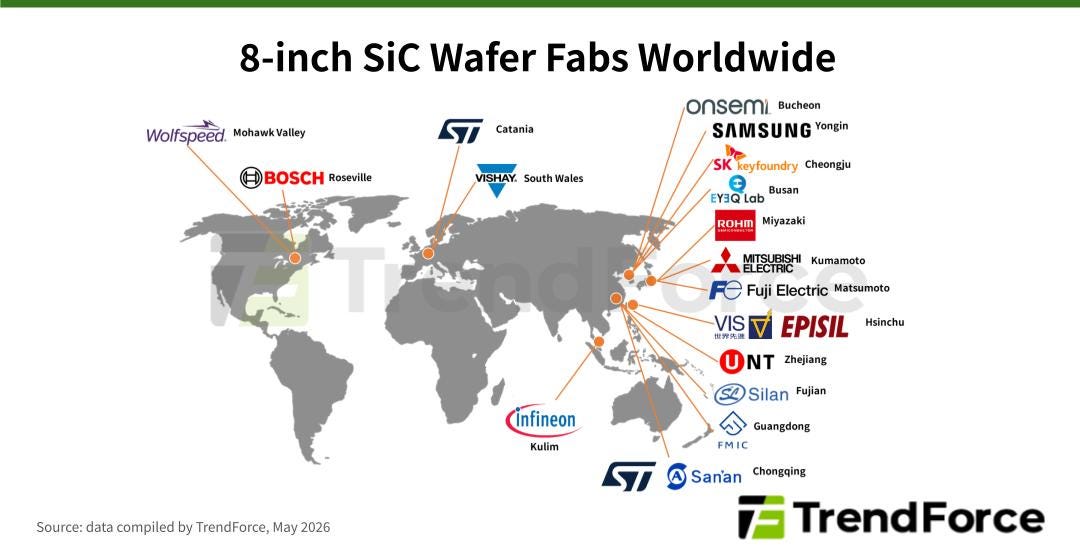
Among major players, Infineon and ROHM are leading the ramp-up of 8-inch SiC production lines, leveraging economies of scale to overcome cost barriers. Infineon combines capacity advantages at its Kulim (Malaysia) facility with integrated Si/SiC/GaN system solutions, strengthening its position in 800V EV platforms and data center power markets. ROHM emphasizes full vertical integration, from SiCrystal wafers to module packaging, while enhancing GaN production efficiency through technology collaboration with TSMC.
VIS demonstrates a differentiated foundry model. By leveraging TSMC technology licensing, it has established a dual-platform strategy combining GaN-on-Si and GaN-on-QST, covering a wide voltage range from 15V to 1,200V and addressing reliability challenges in ultra-high-voltage applications.
For a full analysis of the competitive landscape, access our report: SiC/GaN Power Semiconductors Break “AI Power Wall,” Reshaping Data Center Power Supply.

The AI infrastructure buildout is reshaping supply chains at every layer. Join TrendForce experts and industry leaders at CompuForum 2026 on June 11 in Taipei to explore the strategic shifts ahead. REGISTER NOW.