


The global humanoid robot industry is moving from technology validation to commercial trials, and the competitive focus is shifting to who can build a sustainable business model and who controls key components.
Contents:
China’s ultra-bionic robot boom, and the companion economy behind it
Why the US is betting on AI while China bets on scale
Who really controls the supply chain, mapped out with our new CSCII index
China’s Ultra-Bionic Robots Open a New Companion Economy
As generative AI matures and social trends such as aging populations, falling birth rates, and rising numbers of single-person households reshape demand, robots are shifting from labor substitutes to emotional companions, driving rapid development in China’s ultra-bionic humanoid robots. Unlike traditional humanoid robots that emphasize bipedal walking, lifting, and task execution, these products prioritize lifelike appearance, emotional expression, and natural interaction, aiming to build long-term human-robot relationships. China’s market currently features diverse technical approaches. For instance, AheadForm’s Origin F1 focuses on eye contact, micro-expressions, and a desktop half-body design, using a high degree of facial articulation to reduce the uncanny valley effect. Noetix Robotics’ Hobbs 3 Series targets the desktop companion market, emphasizing synchronized voice and expression, emotional interaction, and family companionship.
Related report: Humanoid Robot Quarterly Report - 3Q26

Unlike most ultra-bionic robots, which use half-body or fixed designs, UBTECH’s UWORLD U1, launched in June 2026, is a full-size humanoid. It combines highly realistic silicone skin, 88 degrees of freedom, a biomimetic cervical spine, and full-body motion control, enabling not only natural facial expressions but also more realistic interaction through complete body movement. On the AI side, it incorporates an emotion-aware LLM that integrates long-term memory, multimodal perception, voice interaction, and on-device AI inference, allowing it to adjust dialogue and interaction style based on the user’s emotional state. TrendForce observes that China’s ultra-bionic humanoid robots are gradually expanding into companionship, entertainment, elder care, and digital content applications, with competition shifting from hardware performance to emotion AI, content services, and overall user experience.

For the supply chain, beyond existing humanoid robot components such as servo motors, reducers, and dexterous hands, demand is also expected to grow for high-fidelity silicone materials, electronic skin, multimodal sensors, microphone arrays, vision modules, edge AI chips, and emotion models, giving rise to a new industry ecosystem that combines mechanical, AI, and consumer electronics characteristics.
US-China Divergence: Intelligence vs. Scale
US: Deepening the AI Ecosystem, Shifting Value from Hardware Specs to Intelligence
The AI ecosystem remains the US’s greatest advantage in humanoid robotics. As generative AI, Vision-Language-Action (VLA) models, and world models mature rapidly, the value of humanoid robots is shifting from hardware specifications to intelligence. Major players such as NVIDIA continue to advance Physical AI platforms including Cosmos, Isaac Lab, and GR00T; Google DeepMind has launched Gemini Robotics to strengthen robotic understanding; and OpenAI is participating in embodied AI model development through investment and research. Together, US firms are forming a complete technology ecosystem spanning large language models, robotics platforms, simulation environments, and AI chips. This reflects the view that as humanoid robots move into complex environments, competitiveness will depend on environmental understanding, multi-step task planning, cross-scenario generalization, and continuous learning.
US companies’ strategies have also shifted from demonstrating hardware capability to building AI capability. Tesla‘s Optimus Gen 3 continues real-world validation on factory floors, with future production focused on improving the robot’s generalization so the same AI can quickly adapt to different work environments. Figure AI is deepening partnerships with large enterprises to train its models on large volumes of real factory data. Boston Dynamics combines years of motion control expertise with AI to strengthen autonomous operation in complex environments. Apptronik generates high-quality data through extensive real-world deployment, feeding it back into the Gemini Robotics training pipeline.
In short, US firms are focused on building a data flywheel, aiming to continuously refine their models with large volumes of real-world data and differentiate their products through AI capability.
China: Accelerating Supply Chain Integration, Shifting from Product Iteration to Scale Deployment
By contrast, China’s humanoid robot development more closely resembles the early development model of electric vehicles: building a complete supply chain and lowering costs quickly, then achieving economies of scale through high shipment volumes. Under this approach, core components such as servo motors, reducers, and lithium batteries can be localized quickly, lowering costs and significantly shortening development cycles.
The two most representative companies are Unitree and AgiBot: Unitree has built a reputation for high value for money and rapid product iteration across both quadruped and humanoid robots, while AgiBot scaled its production from 1,000 to 5,000 units in about a year, and then from 5,000 to 10,000 units in just three months. This shows that China’s advantage today extends beyond manufacturing cost. Its supply chain maturity allows new products to complete component validation, pilot runs, and mass production quickly, giving it a faster iteration pace than its Western competitors.
Notably, as factories, logistics operations, and public venues continue to adopt humanoid robots, China is rapidly accumulating real-world data through large-scale deployment, extending its supply chain advantage into a data advantage. This could help China’s humanoid robot industry form a positive cycle of “deploy, collect data, update the model, redeploy.“ As models continue to improve, the AI gap between China and the US may narrow as a result of China’s data scale.
Supply Chain Power: Component Cost Breakdown and the CSCII
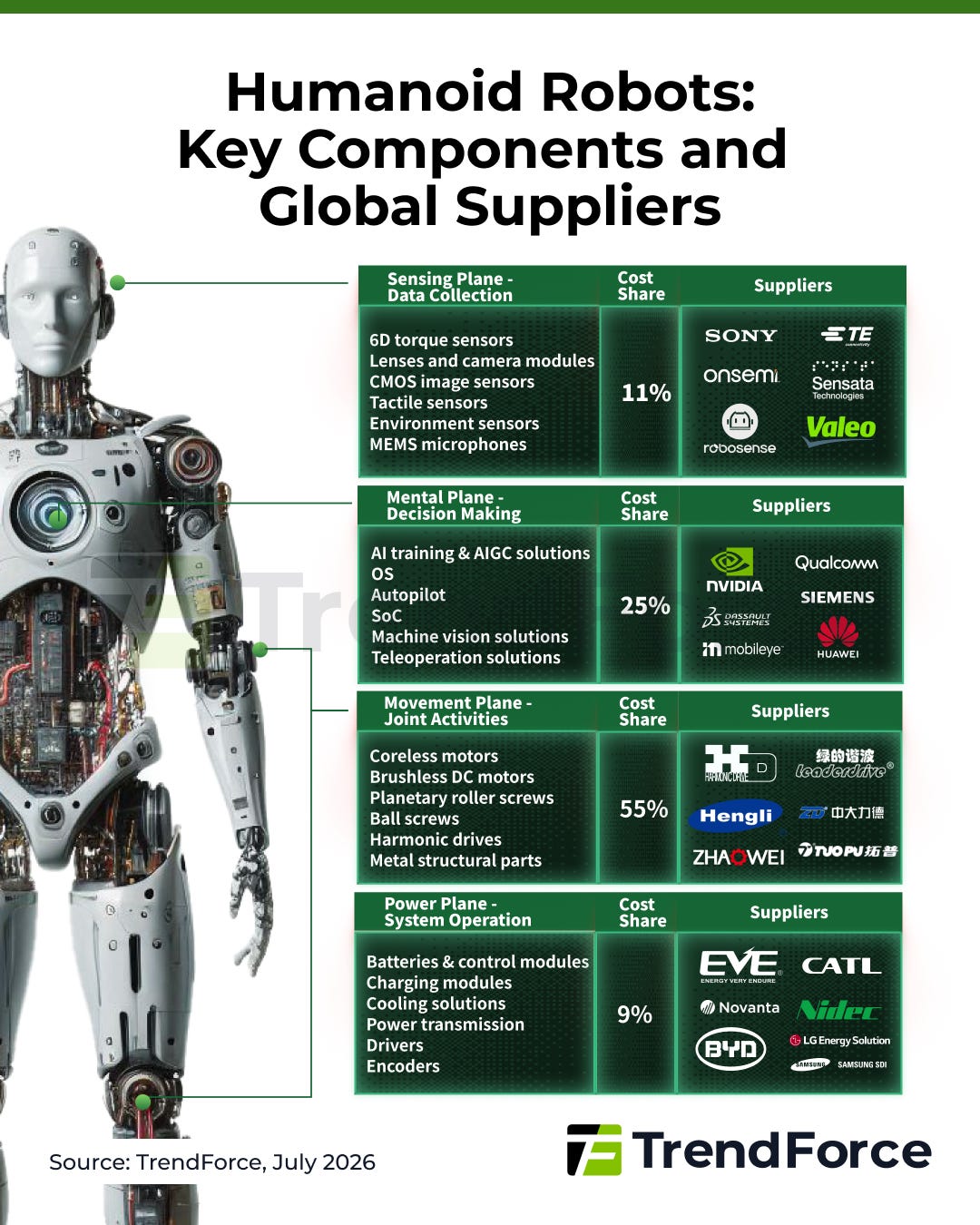
As the humanoid robot industry rapidly takes shape, “who controls the supply of key components” has become a core question in assessing each region’s industrial competitiveness. TrendForce has designed the Component Supply Chain Influence Index (CSCII) to systematically analyze how well each region’s suppliers control different key components.
The CSCII is a composite indicator combining qualitative and quantitative assessment; it is not a single, directly verifiable statistic. Ratings are weighted across five dimensions using expert judgment:
Industry scale position: measuring a component’s global revenue share across industries, reflecting manufacturing scalability.
Technology barriers and substitutability: measuring patent concentration and how quickly followers can catch up.
Humanoid robot application penetration: measuring the breadth of actual design-in by mainstream OEMs in humanoid use cases.
Production capacity and expansion momentum: measuring supply flexibility and manufacturing scaling speed.
Policy and geopolitical supply resilience: factoring in export control exposures and domestic policy support.
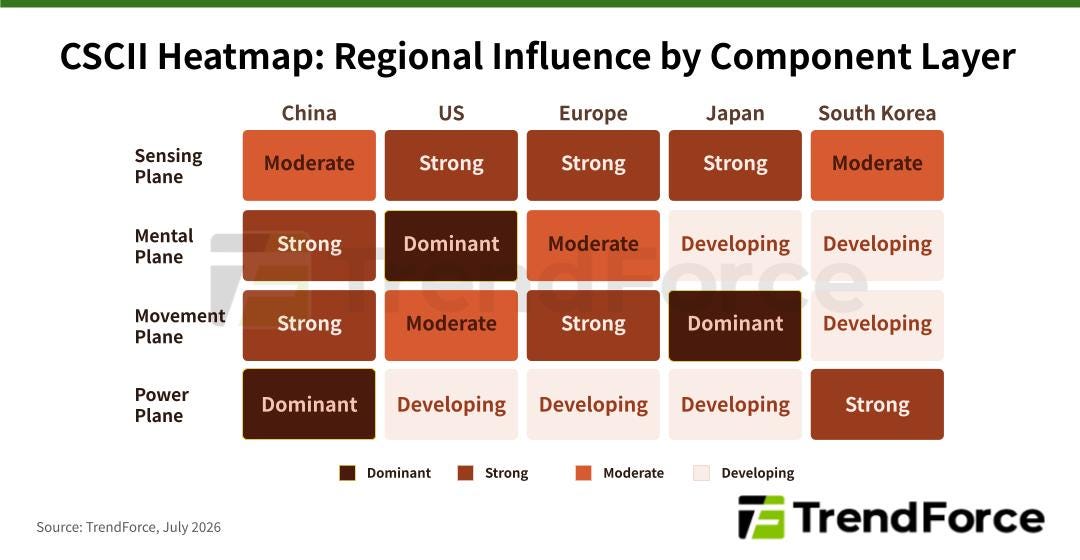
Let’s break it down by region:
China has the most comprehensive presence across all four planes, leading the Power Plane and rated “Strong” in both the Mental and Movement Planes, with its strength built on manufacturing scale and broad component coverage.
The US holds the most pronounced leadership in the Mental Plane, where NVIDIA and Qualcomm command a near-monopoly in AI chips and computing platforms.
Europe is rated “Strong” in both the Sensing and Movement Planes, with its strength concentrated in precision manufacturing. Its companies are less well known than major players in other regions, but carry deep technical value, with German suppliers holding a distinct edge in encoders.
Japan holds a solid lead in the Movement Plane, and its strength is highly concentrated in mechanical transmission, where companies have established deep technology barriers.
South Korea is currently rated “Strong” in the Power Plane, supported by active battery investments from LG and Samsung. Other planes will depend on stronger public-private collaboration to accelerate ecosystem development.
TrendForce View
As the humanoid robot industry moves toward commercialization, companies are shifting their focus from the novelty of product iteration to the durability of their business models. The US and China are pursuing two distinctly different competitive strategies: the US is emphasizing AI, large models, and high-value applications to make its products smarter, while China is leveraging its full manufacturing ecosystem and supply chain advantages to accelerate product iteration and scale deployment.
China’s rapid rise is putting real pressure on US manufacturers today. But over the long run, what will determine the global humanoid robot industry’s landscape is whether companies can build business models that combine scale deployment, data accumulation, and sustainable profitability for their target markets. Given the diversity of commercial use cases and user needs, TrendForce believes that the future market is unlikely to be winner-take-all — multiple players are likely to coexist.
China’s path in the robotics industry is a complex story on its own. In Part 2, we’ll look at how Chinese manufacturers are borrowing from the electric vehicle playbook to localize key components. Subscribe so you don’t miss it.
The deploy–collect–update–redeploy loop may blur the neat “US intelligence vs. China scale” split faster than expected. Manufacturing scale is not only a cost advantage; in embodied AI it creates more edge cases, failure data, maintenance records, and task demonstrations. The key question is whether that data is standardized and reusable across robot platforms, rather than trapped inside individual OEMs. Your CSCII could become even more predictive if paired with a deployment-data index. Which layer currently limits that flywheel most: data rights, teleoperation quality, simulation-to-real transfer, or fleet interoperability?