


In 2026, the global build-out of AI data centers (AIDCs) has entered a critical phase of large-scale deployment. The explosive growth in computing demand is reshaping global power consumption patterns and fueling a new wave of growth in the energy storage market.
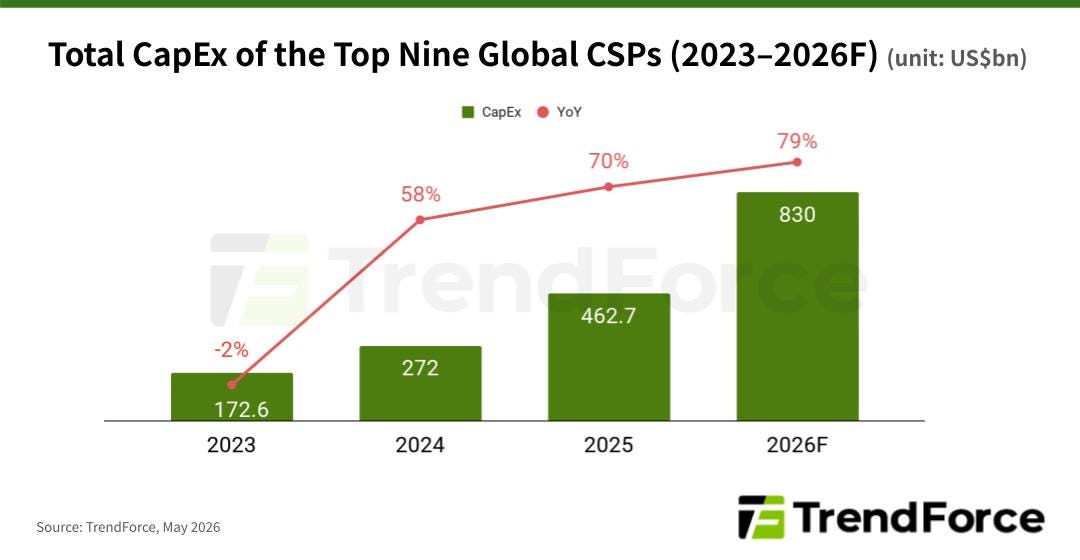
From a CapEx perspective, North American cloud service providers (CSPs) have significantly raised their 2026 capital expenditure guidance, with investment increasingly concentrated in the deployment of high-performance GPU clusters, in-house ASIC development, and next-generation data centers designed to support high-power-density computing.
In China, leading CSPs such as ByteDance and Alibaba are making equally substantial commitments to compute infrastructure. The continued rollout of the East Data West Computing (EDWC) initiative (which redirects eastern computing workloads to western regions to optimize data center distribution and promote balanced regional development) has positioned AIDCs as a core link between the digital economy and the modern power grid.
However, the three defining characteristics of AIDCs — high power density, extreme load volatility, and massive energy consumption — place immense pressure on power systems. To ensure the stable operation of compute workloads, energy storage systems have evolved from an “optional add-on” to “mission-critical infrastructure.”
The following analysis covers energy storage demand dynamics across North American and Chinese markets, as well as the energy storage solutions offered by major Chinese manufacturers. Insights on the Chinese market draw on TrendForce’s ongoing primary research and long-term coverage of the local industry.
North America and China: Different Challenges, One Common Need
The enormous power demands of AIDCs are driving regional grid loads sharply higher, widening energy supply gaps. North America and China face distinct challenges, but both are accelerating energy storage deployment as a result.
North American Market: Grid Constraints and Gas Turbine Shortages Drive Urgent Storage Demand
North America is a core hub for global AIDC development, with electricity supply heavily dependent on natural gas — gas-fired generation accounts for 40–50% of the energy mix across most regions. Surging AIDC power demand has further tightened large gas turbine supplies. Faced with growing supply-demand imbalances and an escalating risk of grid outages, AIDC operators are under pressure to increase their share of renewable energy generation. However, the inherent intermittency and volatility of solar and wind power mean that robust energy storage systems are essential to guarantee 24/7 uninterrupted data center operations.
Chinese Market: Policy Support and Resource Optimization Accelerate Storage Integration
China’s AIDC build-out is driven by national strategic initiatives, with optimizing regional resource allocation at its core. The government has incorporated “Computing-Power Synergy” (the coordinated planning of AI compute infrastructure and power systems) into new infrastructure projects, encouraging compute facilities to deploy advanced and grid-forming energy storage systems.
In practice, power grids in China’s eastern compute hubs are approaching their load capacities, while grid infrastructure in renewable-rich western regions remains relatively fragile. Ultra-high-voltage (UHV) transmission networks alone cannot fully mitigate the pulsed load shocks generated by AIDCs. Coupled with regulatory requirements for green electricity consumption, grid-forming energy storage and long-duration energy storage (LDES, predominantly 4–8 hours) have consequently become standard configurations for compute hubs, further accelerating the pace of energy storage integration.
Related report: Mutual Empowerment of AI Computing Power and Electricity: Power Grid, Long-Duration Energy Storage, and New Power System Transformation
AIDC Storage Demand on Two Fronts
AIDC energy storage is primarily deployed across two domains: the data center side and the generation side. On the data center side, during Large Language Model (LLM) training, AIDCs experience severe, pulse-like power transients that place extreme demands on power continuity and grid resilience. To address this challenge, NVIDIA's 800V DC architecture white paper highlights the need for a layered storage approach, leading to a two-tier deployment: external (facility-level) and internal (rack-level) storage.
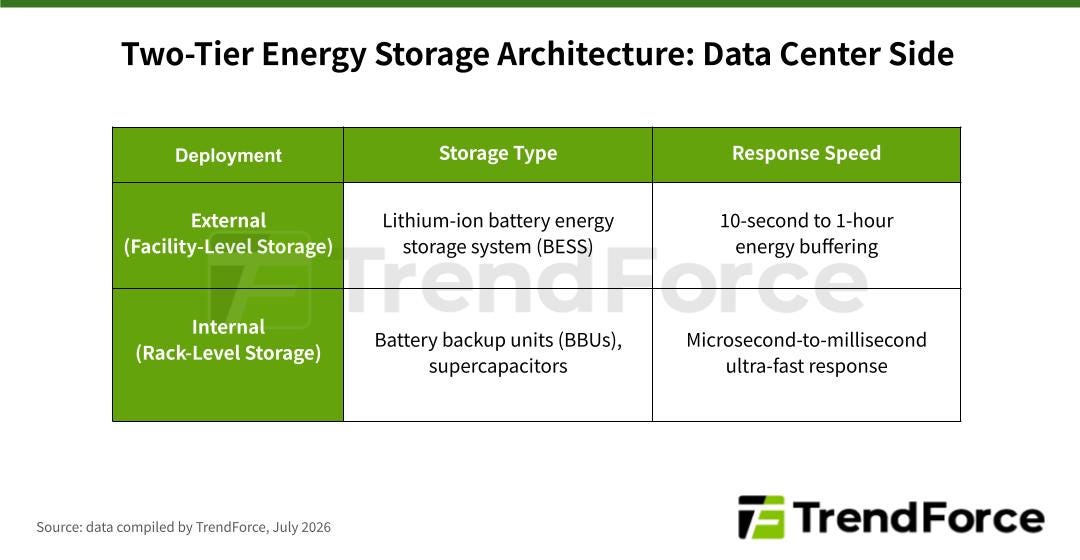
External (Facility-Level) Storage serves as reliable backup power, keeping grid load volatility under 2%; BESS can also participate in grid peak shaving and ancillary service markets. Additionally, they provide essential frequency regulation for on-site captive generation such as gas turbines and nuclear reactors.
Internal (Rack-Level) Storage addresses immediate power anomalies within the facility. BBUs leverage DC-DC conversion for high efficiency, low parasitic power draw, and a compact form factor, suitable for distributed integration directly inside high-power-density AI server racks. Supercapacitors complement this by enabling instantaneous discharge of massive electrical transients with near-zero energy loss.
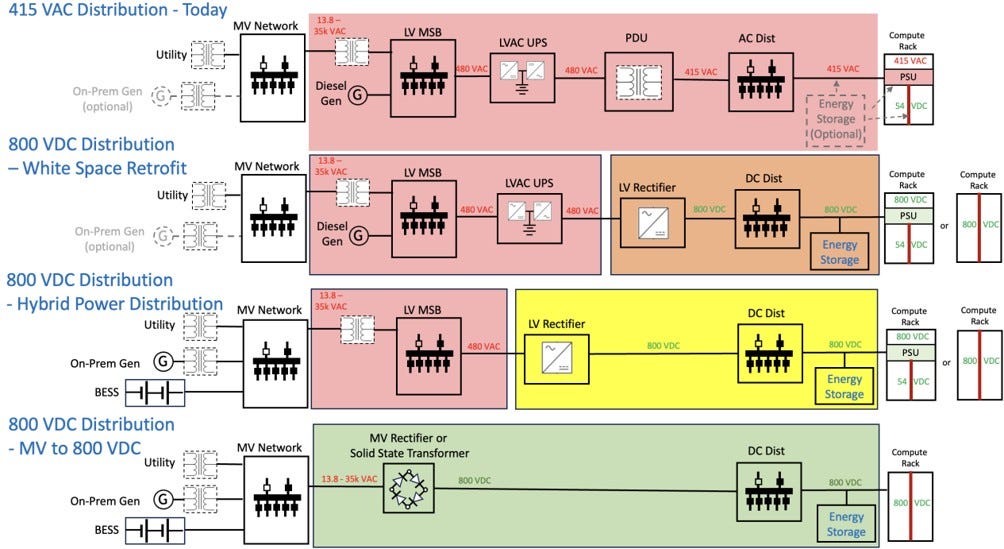
Related report: NVIDIA AI Server Power Roadmap & Data Center Build Risk
On the generation side, as the costs of solar modules and energy storage systems continue to decline, the levelized cost of energy (LCOE) for solar-plus-storage has fallen below that of conventional generation sources such as natural gas and nuclear power, giving solar-plus-storage a distinct cost advantage. As the green electricity transition accelerates AIDC adoption of renewable energy globally, energy storage systems play a critical role in ensuring stable alignment between variable renewable supply and the continuous, high-load power demands of data centers.
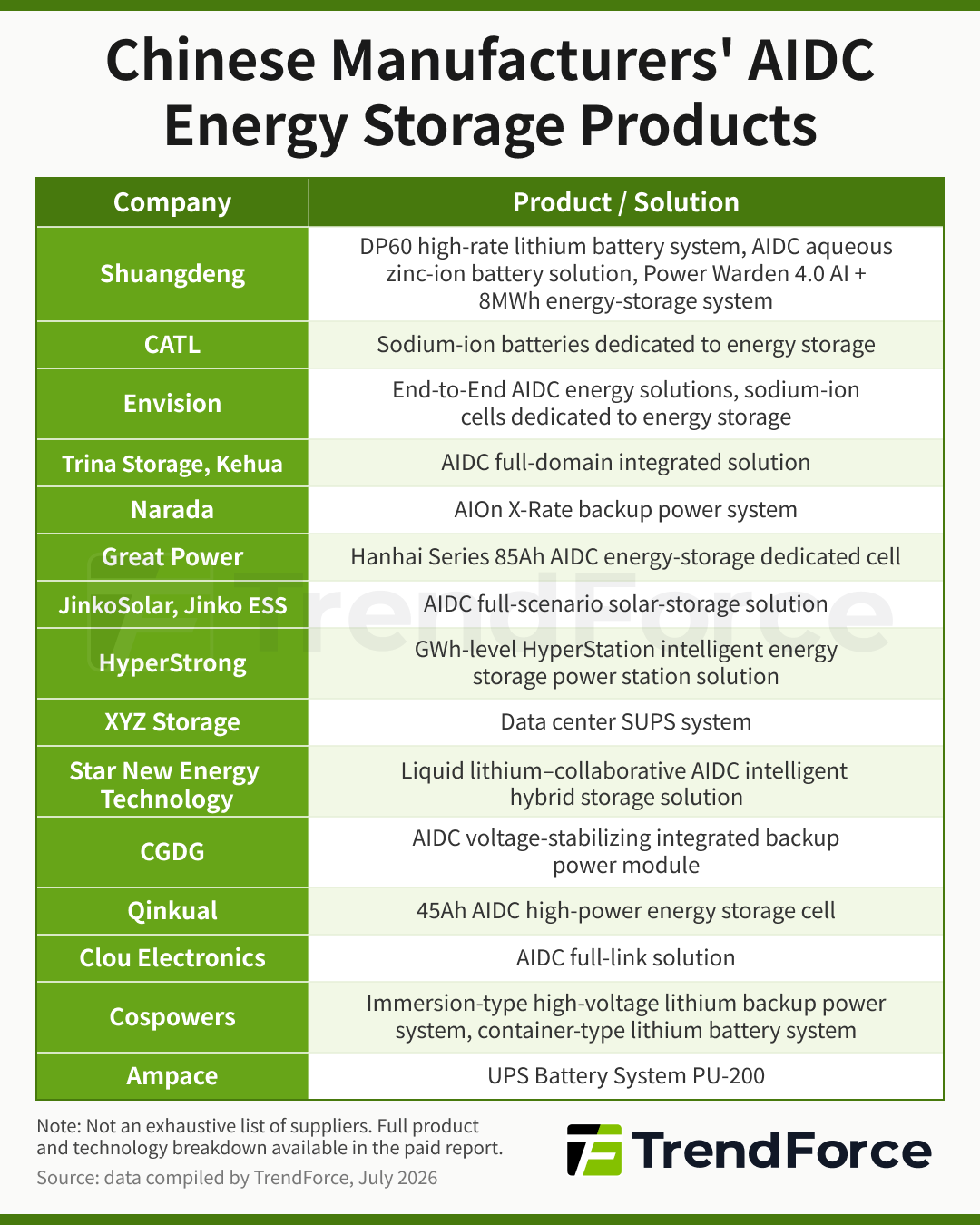
China’s Energy Storage Supply Chain: Accelerating Cell and Systems Technology Upgrades
This wave of AIDC-driven demand is accelerating technology development among Chinese energy storage manufacturers.
Cell technology is advancing toward higher reliability, efficiency, and safety.
Systems technology encompasses grid-forming storage, high-voltage DC (HVDC) architecture, liquid cooling, and long-duration energy storage.
TrendForce View
The global energy storage market in 2026 is entering a new phase of demand restructuring driven by AIDCs. Across the value chain, solar, wind, and storage are integrated on the generation side; grid-forming storage supports the grid side; and layered BESS, BBU, and supercapacitor protection covers the load side. At the dispatch level, AI-powered energy management systems (EMS) enable real-time matching of computing load and power supply. Together, these form a new type of infrastructure defined by the efficient synergy of computing power, electric power, and energy storage.
TrendForce believes that AIDCs will continue to provide steady growth momentum for the energy storage sector. Energy storage will play an increasingly critical role in securing compute reliability and advancing energy transition.
For an in-depth analysis and vendor breakdown, access our full report: 2026 Energy Storage Turning Point: AIDC Fuels Dual-Engine Demand Growth
On the rack-level ultra-fast layer you mentioned—supercapacitors and BBUs—that tier isn’t limited to Chinese vendors. The microsecond-transient segment is dominated by Japanese incumbents: Nippon Chemi-Con and TDK in EDLCs, plus the lithium-ion capacitor (LIC)—a higher-density hybrid that fits perfectly into this high-cycle, high-safety rack niche, where Musashi Energy Solutions and Taiyo Yuden are the leading names. China dominates the facility-level BESS cells; the load-side passive buffer is a market where Japan holds greater sway.